Career Assessment Test India: How to Choose the Right One
Not all career assessment tests are created equal. Here's how to choose the right one in India — and what to avoid.
Dr. RK Singh
Founder, The CoacHR
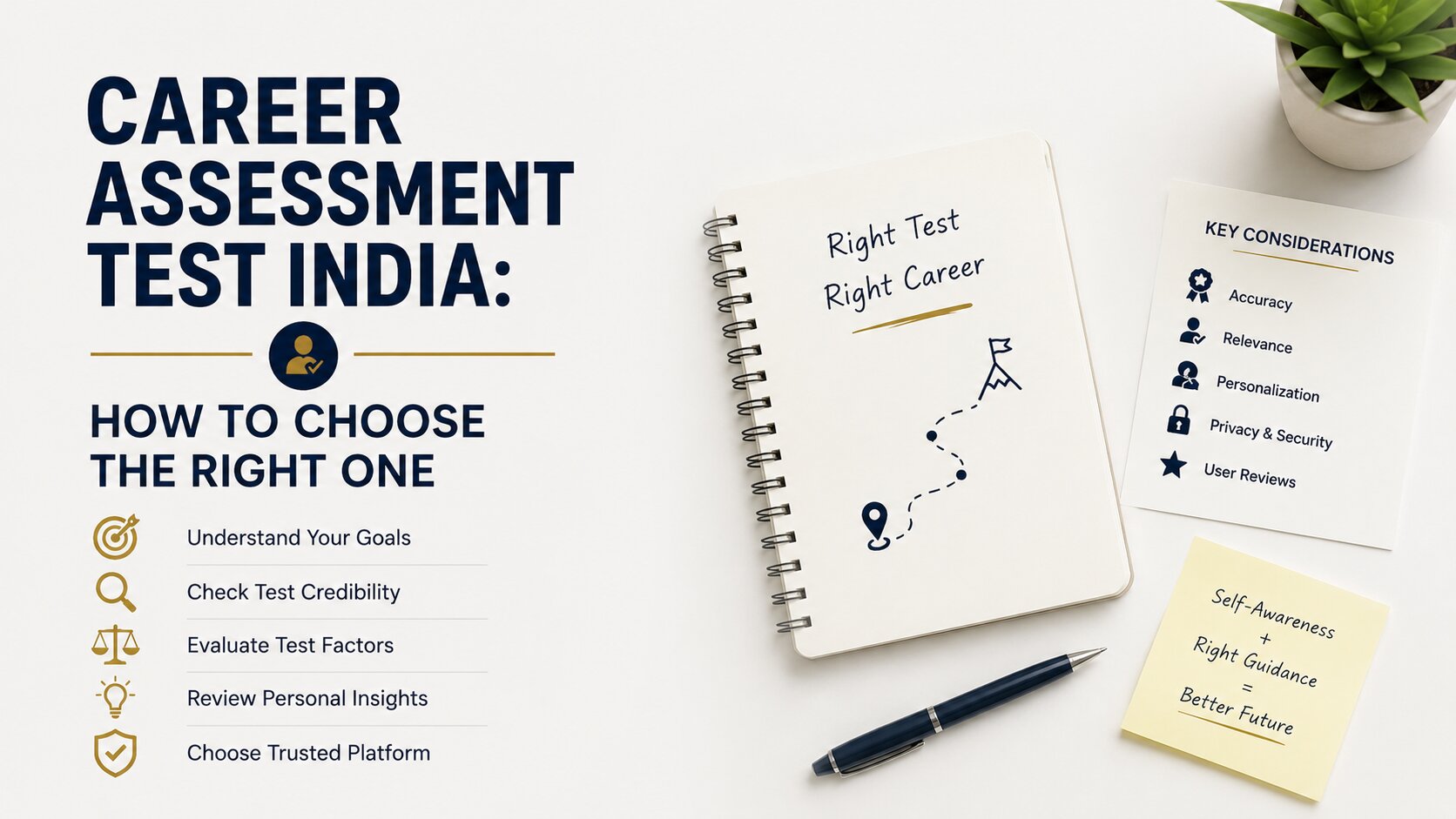
Career Assessment Test India: How to Choose the Right One
Search for "career assessment test India" and you'll find hundreds of options — free five-minute quizzes, paid personality tests, government career counselling portals, and premium coaching programs, all claiming to reveal your ideal career path. The sheer volume makes it genuinely hard to know which one is actually worth your time, and which one is just a lead-generation quiz dressed up as science.
Here's a practical framework for choosing the right career assessment test India actually has to offer — without wasting weeks comparing options.
Why Not All Career Assessments Are Equal
Before comparing specific tests, it helps to understand the spectrum you're choosing from:
Free, unvalidated quizzes — often built for engagement (social sharing), not accuracy. Fun, but not a reliable basis for career decisions.
Standardized personality tests (adapted for career use) — reasonably reliable for measuring personality traits, but often generic and not India-market-specific.
Structured career diagnostic tools — combine personality data with skills and market benchmarking; more actionable but vary widely in quality.
Comprehensive career audits — combine psychometric assessment with employability scoring, skill-gap analysis, and expert interpretation; the most thorough option, but require more time investment (60-90 minutes plus a coaching session).
Most people default to option 1 because it's free and instant — but it's also the least useful for actual decision-making.
Five Questions to Ask Before Choosing a Career Assessment
1. Is It Validated, or Just Entertaining?
Ask whether the assessment is built on established psychological frameworks or whether it's a marketing quiz designed primarily to collect your email address. A quick giveaway: if the "results" feel suspiciously flattering regardless of how you answer, it's probably not measuring much.
2. Does It Account for the Indian Job Market Specifically?
Many popular career tests are built for Western job markets and don't account for India-specific realities — the prevalence of certain sectors (IT services, BPO, manufacturing), regional salary benchmarks, or the specific pressures Indian professionals face (family expectations, city-specific job availability, sector consolidation). A career counsellor India professionals trust should factor these realities into interpretation, not just generic global data.
3. Does It Go Beyond Personality Into Employability?
Personality is only one input. A good assessment should also tell you something about your actual market position — how employable your current skill set is, and what specific gaps stand between you and your next role. If a test only gives you a personality "type" with no market context, it's incomplete.
4. Is There Human Interpretation, or Just an Automated Report?
Automated reports are useful as a starting point, but the most valuable assessments include a session with a trained coach who can interpret your specific results, answer follow-up questions, and connect the findings to a concrete action plan.
5. Does It Lead to a Roadmap, or Just a Label?
The single biggest test of quality: does the assessment end with "here's your personality type," or does it end with "here's what this means for your next 6-12 months"? The former is entertainment; the latter is actual career guidance.
Comparison Framework
Free Online Quiz — Cost: Free. Time: 5-10 mins. India-market context: Rarely. Employability scoring: No. Human interpretation: No. Actionable roadmap: No. Best for: Casual curiosity.
Standard Personality Test — Cost: Low-moderate. Time: 15-20 mins. India-market context: Sometimes. Employability scoring: No. Human interpretation: Rarely. Actionable roadmap: Rarely. Best for: General self-awareness.
Comprehensive Career Audit — Cost: Moderate. Time: 60-90 mins. India-market context: Usually. Employability scoring: Yes. Human interpretation: Yes. Actionable roadmap: Yes. Best for: Actual career decisions.
Red Flags to Watch For
When evaluating a career diagnostic test, be cautious of:
Results that are vague enough to apply to almost anyone ("You're a natural leader with great potential!")
No explanation of the methodology or psychological framework behind the test
Immediate upsells to expensive coaching packages before you've even seen your results
No option to speak with an actual human about your results
Assessments that ignore Indian market realities entirely and appear to be generic Western templates
What "Good" Actually Looks Like
A strong career assessment test India professionals should look for typically:
Takes 30-90 minutes and asks scenario-based, not simplistic yes/no, questions
Produces a report covering personality, workstyle, and employability — not personality alone
Includes at least a brief session with a trained coach to interpret results
Provides specific, actionable next steps rather than just descriptive labels
Factors in Indian sector trends, salary benchmarks, and market realities
An Illustrative Example
Consider a fresher who had taken three different free online career quizzes over a few months and received three completely different "ideal career" suggestions — one suggesting marketing, another suggesting finance, a third suggesting creative fields. The inconsistency wasn't a personal failing; it reflected the low reliability of unvalidated free tools. A single, structured career diagnostic test with proper psychometric validation and expert interpretation produced a far more consistent and actionable result — because it measured underlying traits rather than surface-level mood-based responses.
Should You Pay for a Career Assessment?
This is a fair question, especially for freshers and recently laid-off professionals watching their spending closely. The honest answer: free tools are fine for casual exploration, but if you're making a real decision — choosing a first career path, planning a career switch, or recovering from a layoff — the cost of a poor decision (wasted months, a mismatched job, another failed transition) is almost always higher than the cost of a properly validated assessment.
The CoacHR Approach
At The CoacHR, our career mapping tool and assessment process is specifically designed around Indian market realities — combining validated psychometric instruments with employability scoring and CHRO-level interpretation, so you leave with an actual roadmap, not just a personality label.
Frequently Asked Questions
Q: Are free online career tests completely useless?
Not useless, but limited — treat them as casual exploration rather than a basis for major career decisions.
Q: How much should a good career assessment cost in India?
Pricing varies, but a comprehensive assessment with human interpretation typically costs more than a basic automated report, reflecting the added expertise involved.
Q: Can one assessment really capture something as complex as my career fit?
No single assessment is perfect, but a validated, comprehensive one combining personality, workstyle, and employability data is far more reliable than any single-dimension quiz.
Q: Does The CoacHR's assessment account for Indian job market trends?
Yes — our assessment and coaching process is built specifically around Indian sector trends and market realities.
Ready for an assessment that actually leads somewhere? Explore The CoacHR's career assessment and get real answers, not just a label.
Related Articles
What to Do If You Didn't Get the CHSE Result You Expected
Not getting the CHSE result you hoped for can feel disappointing, but it doesn't define your future. Whether you're considering an improvement exam, choosing a different college, or exploring career alternatives, this guide explains the practical steps every Odisha student should know to make informed decisions after Class 12.

Will AI Take Your Job? How Bhubaneswar Professionals Can Future-Proof Their Careers
It's not AI that ends careers — it's staying static while everyone else adapts. Here's how to know exactly where you stand.