What Is an Employability Score and Why It Matters More Than Your Resume
Your resume is a record of what you've done. Your **employability score** is a prediction of what you're capable of doing next — and, increasingly, that forward-looking measure matters more to your career trajectory than a polished list of past job titles ever could. If you've never encountered this concept before, here's a full breakdown of what an employability score actually is, how it's calculated, and why it's becoming a more useful career metric than the resume itself.
Dr. RK Singh
Founder, The CoacHR
What Is an Employability Score and Why It Matters More Than Your Resume
Your resume is a record of what you've done. Your employability score is a prediction of what you're capable of doing next — and, increasingly, that forward-looking measure matters more to your career trajectory than a polished list of past job titles ever could.
If you've never encountered this concept before, here's a full breakdown of what an employability score actually is, how it's calculated, and why it's becoming a more useful career metric than the resume itself.
What Is an Employability Score?
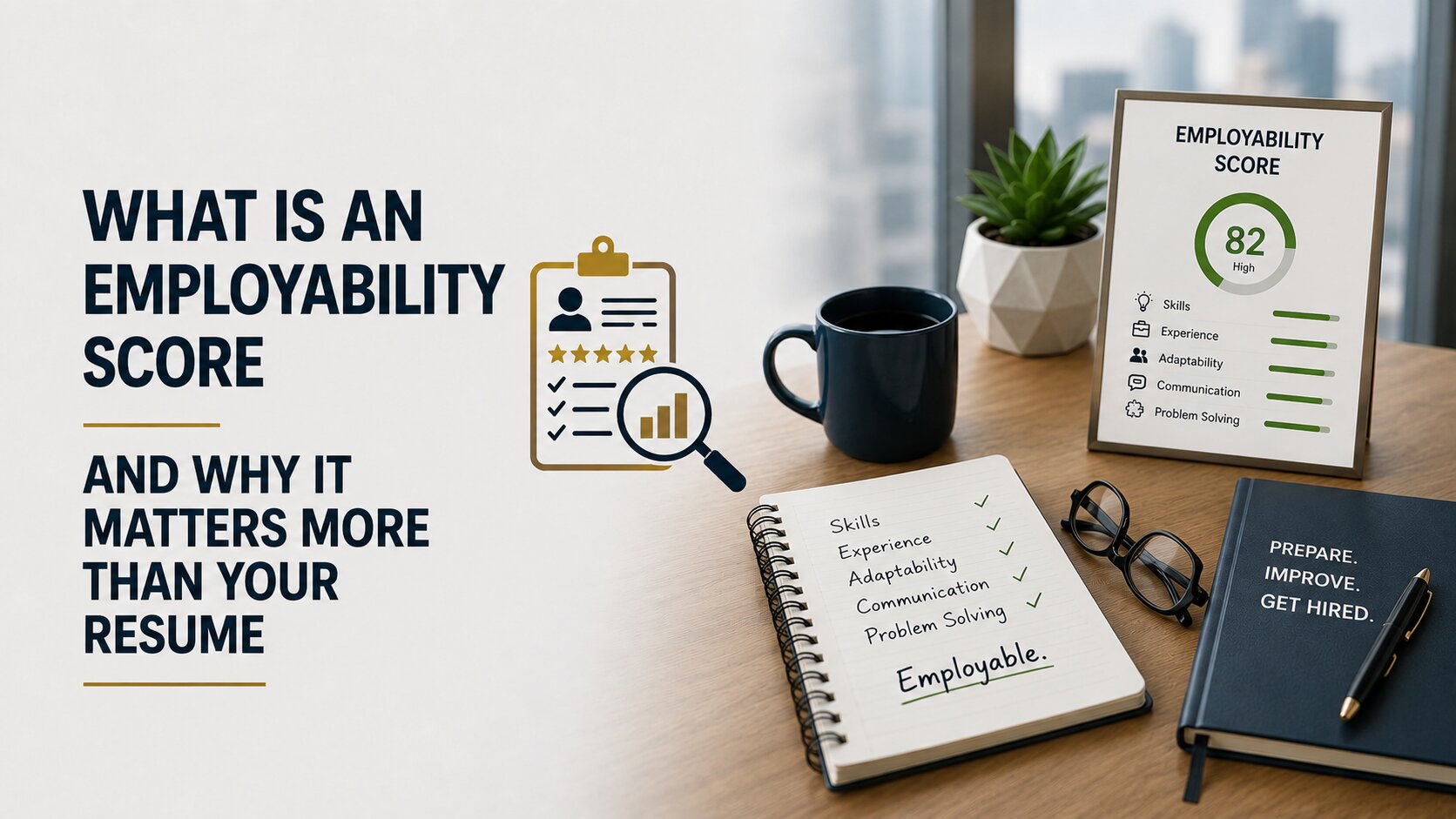
An employability score is a quantifiable measure of how "market-ready" your current professional profile is — combining your skills, experience, adaptability, and market demand for your capabilities into a single, objective metric. Instead of a vague sense of "I think I'm doing okay," it gives you an actual number (or tier) you can track, benchmark, and improve.
Think of it as a credit score, but for your career: a single number that reflects a complex combination of underlying factors, updated over time as those factors change.
Why Your Resume Doesn't Tell the Whole Story
A resume is fundamentally backward-looking. It tells a hiring manager what you did — but it doesn't quantify:
How your current skill set compares to what the market actually demands right now
How exposed your role is to automation or restructuring
How adaptable your skill set is across different industries or functions
Whether your experience is trending toward increasing or decreasing market value
Two professionals with nearly identical resumes — same job titles, same years of experience — could have very different employability scores, because one has kept pace with evolving market demands while the other hasn't. A resume alone would never reveal this gap.
What Goes Into Calculating an Employability Score
While exact methodologies vary between providers, a robust employability score typically factors in:
Core skill relevance — how well your current skills map to in-demand market skills
Adaptability indicators — how transferable your skills are across roles and industries
Learning trajectory — whether you've been actively upskilling or have stagnated
Market demand data — how much current demand exists for your specific role and skill combination
Risk exposure — how vulnerable your current function is to automation or restructuring (this overlaps closely with a career risk assessment)
Increasingly, AI career analysis is used to process these inputs — analyzing large volumes of market and job-posting data to benchmark an individual's profile far more precisely than manual assessment alone could achieve.
Why This Matters More Than Ever in 2026
Traditionally, professionals assumed their market value grew automatically with tenure — more years in the workforce meant more value, by default. That assumption no longer holds. In a market being actively reshaped by AI and automation, some skill sets are appreciating rapidly in value while others are depreciating just as fast, regardless of how many years someone has spent using them.
An employability score captures this reality in a way tenure or job titles simply cannot. It answers the question that actually matters: not "how long have you worked?" but "how valuable is what you can do, right now, in today's market?"
Employability Score vs. Career Future Readiness Score
These two are related but distinct:
Employability score measures the current market-readiness of your skills and profile — present time orientation.
Career future readiness score goes a step further — projecting how resilient your career trajectory is likely to be as industries, roles, and required skills continue to shift over the next several years — future time orientation.
A Simple Way to Think About It
Imagine two professionals in similar roles: Professional A has spent the last three years deepening expertise in a skill area that's increasingly being automated. Professional B has spent the same three years in a similar role but has proactively picked up adjacent, higher-demand skills. Their resumes might look almost identical on paper — same title, same tenure — but their employability scores would likely diverge significantly, because one profile is trending toward increasing market relevance and the other isn't.
This is exactly the kind of insight a resume alone will never surface, but a structured skill gap analysis combined with employability scoring reveals clearly.
How to Actually Improve Your Employability Score
Once you know your score, the natural next question is how to move it. Common levers include:
Closing specific skill gaps identified through assessment, rather than generic upskilling
Diversifying transferable skills so your profile isn't overly dependent on a single function
Staying ahead of automation trends in your specific industry, rather than reacting after disruption hits
Gaining visibility into adjacent, higher-demand roles your current skills could realistically transfer into
The key difference between this approach and generic "keep learning" advice is specificity — an employability score, done properly, tells you exactly which gaps matter most for your particular profile, rather than a one-size-fits-all list of trending skills.
An Illustrative Example
Consider a professional in a customer support role who assumed their experience alone made them broadly employable. An employability assessment revealed a below-benchmark score — not because of poor performance, but because their specific skill combination overlapped heavily with functions increasingly handled by AI-driven support tools. The same assessment, however, identified a closely related and rapidly growing adjacent function — customer success and retention strategy — where their underlying skills scored significantly higher on employability. That single insight redirected months of otherwise unfocused job searching into a much more targeted, higher-probability path.
Why This Should Be Part of Every Career Audit
An employability score is most useful when it isn't viewed in isolation — it should sit alongside psychometric data, skill-gap analysis, and career risk assessment as part of a complete career audit. Combined, these elements answer not just "how employable am I right now?" but "what should I specifically do to become more employable, and how urgent is that action?"
The CoacHR Approach
At The CoacHR, employability scoring is a core component of our career audit — combined with AI-driven market analysis and CHRO-level interpretation, so you get a precise, benchmarked view of where you stand and a clear roadmap to improve it.
Frequently Asked Questions
Q: Is an employability score the same as a credit score for careers?
It's a useful analogy — both condense complex underlying factors into a single, trackable, improvable metric.
Q: Can my employability score improve over time?
Yes — targeted skill development, closing specific gaps, and increasing adaptability can meaningfully shift your score.
Q: Is a high employability score the same as job security?
Not identical, but closely related — a higher score generally indicates lower risk exposure and more available options if your current role changes.
Q: How is an employability score different from years of experience?
Experience measures time; employability measures current market relevance — which doesn't always increase automatically with tenure.
Want to know your actual employability score, not just a guess? Get a career audit with The CoacHR and find out where you really stand.