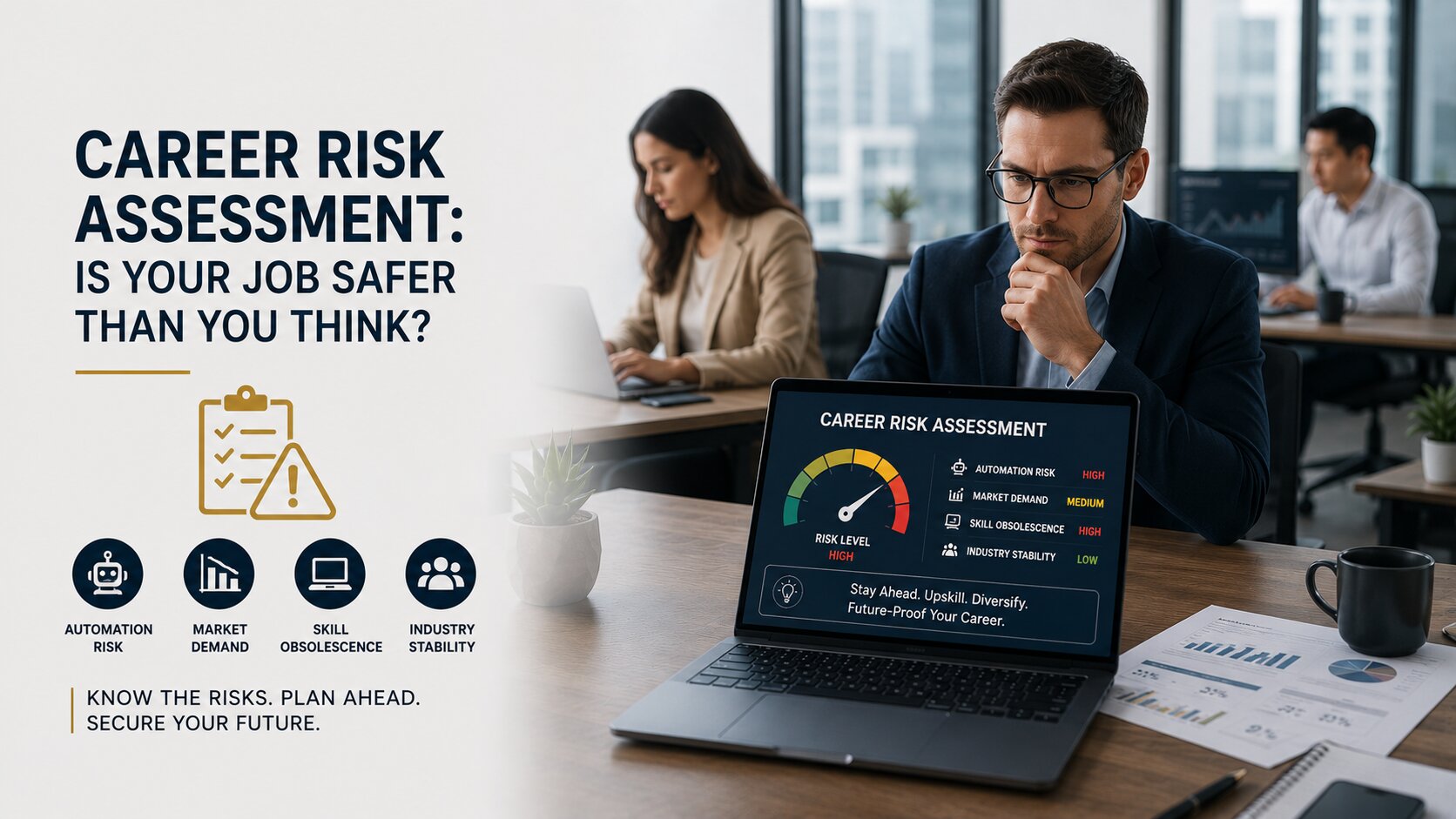
Career Risk Assessment: Is Your Job Safer Than You Think?
Read this definitive career risk assessment to find out why your job is safer than you think—and learn how to future-proof your skills for tomorrow.
Dr. RK Singh
Founder, The CoacHR
Inside the Career Future Readiness Score: How We Calculate It
If someone asked you right now, "How future-proof is your career?" — could you answer with anything more specific than a shrug? Most professionals can't, because "future-proof" has always been treated as a vague aspiration rather than something you can actually measure. That's exactly the gap the career future readiness score is built to close.
What Is the Career Future Readiness Score?
The career future readiness score is a forward-looking metric that quantifies how well-positioned your current career trajectory is to withstand — and ideally benefit from — the structural shifts reshaping the job market: AI adoption, automation, industry consolidation, and evolving skill demands.
Where an employability score test tells you how market-ready you are today, the future readiness score answers a different, arguably more important question: how likely is that readiness to hold up over the next 3-5 years, given where the market is heading?
Why "Future Readiness" Needed Its Own Metric
For most of modern career history, skills depreciated slowly. A skill learned at 25 might remain relevant at 45 with only incremental updates. That's no longer a safe assumption. Entire categories of tasks — not just jobs, but specific tasks within jobs — are being automated or fundamentally restructured within a handful of years, sometimes faster.
This creates a real blind spot: a professional could have a strong current employability score while simultaneously being on a trajectory that's rapidly losing future relevance. Without a forward-looking measure, that risk stays invisible until it's already a crisis — which is precisely the scenario a future readiness score is designed to prevent.
How the Score Is Calculated: The Core Components
While methodologies can vary, a robust career future readiness score is generally built from four core inputs:
1. Automation and AI Exposure
This measures how susceptible your current role's core tasks are to automation or AI-driven tools, based on industry trend analysis and AI career analysis of how similar roles are evolving across sectors.
2. Skill Transferability
This evaluates how portable your current skills are across adjacent industries and functions. Highly specialized, narrow skill sets tend to score lower here than skills with broad cross-industry applicability — not because specialization is bad, but because it carries more concentrated risk.
3. Learning Trajectory and Adaptability
This looks at your demonstrated pattern of skill acquisition over time. Someone actively building adjacent, in-demand skills scores meaningfully higher than someone whose skill profile has remained static, even if their current employability is similar.
4. Industry and Sector Trend Alignment
This factors in the broader trajectory of your specific industry — whether it's expanding, contracting, consolidating, or being restructured — since even strong individual skills carry more risk within a structurally shrinking sector.
How These Combine Into a Single Score
Each component is weighted and combined to produce an overall score, generally presented as a tier or range (for example, low/moderate/high future readiness) rather than a single arbitrary number, since the goal is actionable interpretation, not false precision.
Automation exposure — Low readiness looks like: core tasks highly automatable. High readiness looks like: tasks requiring judgment, relationship, or complex problem-solving.
Skill transferability — Low readiness looks like: narrow, single-industry skill set. High readiness looks like: skills applicable across multiple industries/functions.
Learning trajectory — Low readiness looks like: no new skills in 12+ months. High readiness looks like: active, targeted upskilling in adjacent areas.
Sector trend alignment — Low readiness looks like: contracting or heavily disrupted sector. High readiness looks like: growing or stable sector.
Why This Score Matters More Than It Might Seem
It's tempting to dismiss this as an abstract, future-oriented number that doesn't affect today's decisions. In practice, it directly shapes very concrete choices:
Whether to invest in deepening current skills or diversifying into adjacent ones
Whether now is the time to consider a proactive career switch, rather than waiting for disruption to force it
Which specific skills are worth prioritizing in the next 6-12 months
How urgently to act, versus how much time you realistically have
Without this score, these decisions default to guesswork or generic advice ("just keep learning"). With it, they become specific and prioritized.
An Illustrative Example
Consider a data-entry-heavy operations professional with strong current performance reviews and a solid employability score based on experience and reliability. A future readiness assessment, however, revealed high automation exposure in the core tasks of the role, combined with low skill transferability, since the specific tools used were narrow and increasingly being replaced by AI-driven systems. This didn't mean immediate crisis — but it did mean the readiness score flagged a 2-3 year window to proactively build adjacent skills (such as process design or systems oversight) before the automation trend fully materialized in that specific function. That's a fundamentally different, more actionable insight than "you're doing fine right now."
Future Readiness Score vs. Career Risk Assessment: What's the Difference?
These overlap significantly but aren't identical:
A career risk assessment typically focuses narrowly on immediate threat factors — how likely your specific role is to be affected by layoffs, restructuring, or automation in the near term.
The career future readiness score takes a broader, longer-horizon view — combining risk with adaptability, learning trajectory, and transferability to project overall trajectory, not just immediate threat level.
In practice, a comprehensive career audit report includes both, since immediate risk and longer-term readiness answer related but distinct questions.
How to Use This Score Practically
A future readiness score is only useful if it translates into action. The practical sequence typically looks like:
Get your score and understand which component is dragging it down (automation exposure, transferability, learning trajectory, or sector alignment)
Identify 2-3 specific, targeted actions addressing that weakest component — not a generic upskilling list
Set a realistic timeline based on how urgent the underlying trend actually is
Reassess periodically, since both the market and your own skill profile will continue to shift
Why This Requires Data, Not Intuition
It's worth being honest: most professionals significantly overestimate or underestimate their own future readiness, because intuition tends to be anchored to current performance and comfort rather than actual market trend data. This is exactly why data-driven career guidance — built on real market and industry analysis rather than gut feeling — produces meaningfully different, and often more urgent, conclusions than self-assessment alone.
The CoacHR Approach
At The CoacHR, the career future readiness score is calculated as part of our comprehensive career audit, combining AI-driven market and industry trend analysis with expert coaching interpretation — so you get a clear, specific, and actionable picture of where your career trajectory is actually heading, not just where it stands today.
Frequently Asked Questions
Q: How is the career future readiness score different from an employability score?
Employability measures current market-readiness; future readiness projects how that readiness is likely to hold up over the next several years.
Q: Can my future readiness score improve?
Yes — targeted skill development, especially in transferable and adaptability-focused areas, can meaningfully improve the score over time.
Q: Is a low future readiness score a reason to panic?
No — it's a reason to act early and specifically, while there's still time to build the relevant skills, rather than waiting for disruption to force the issue.
Q: How often should I reassess my future readiness score?
Roughly annually, or sooner if your industry is undergoing visible, rapid change.
Want to know how future-proof your career actually is? Get your career future readiness score with The CoacHR.
Related Articles
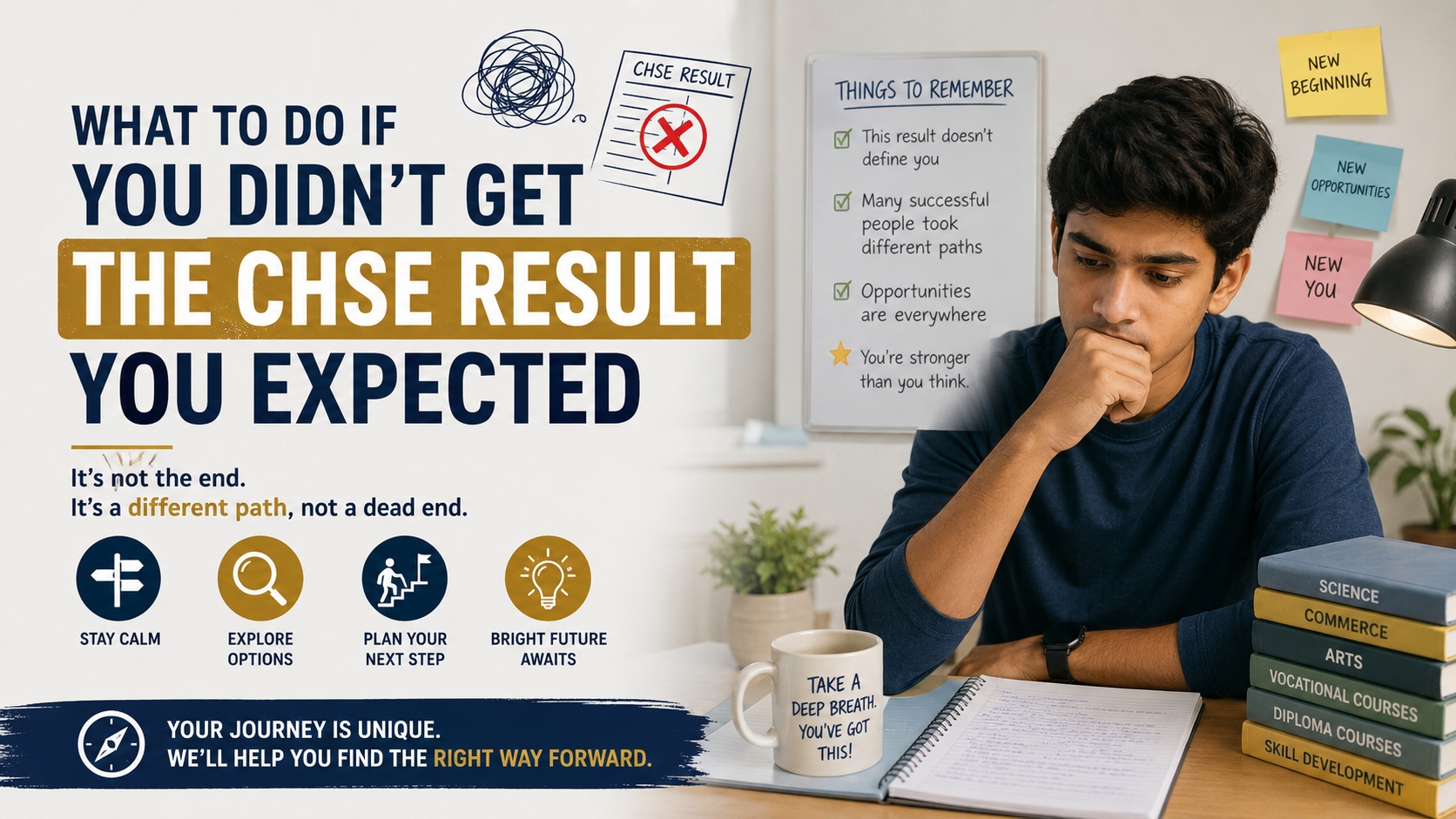
What to Do If You Didn't Get the CHSE Result You Expected
Not getting the CHSE result you hoped for can feel disappointing, but it doesn't define your future. Whether you're considering an improvement exam, choosing a different college, or exploring career alternatives, this guide explains the practical steps every Odisha student should know to make informed decisions after Class 12.
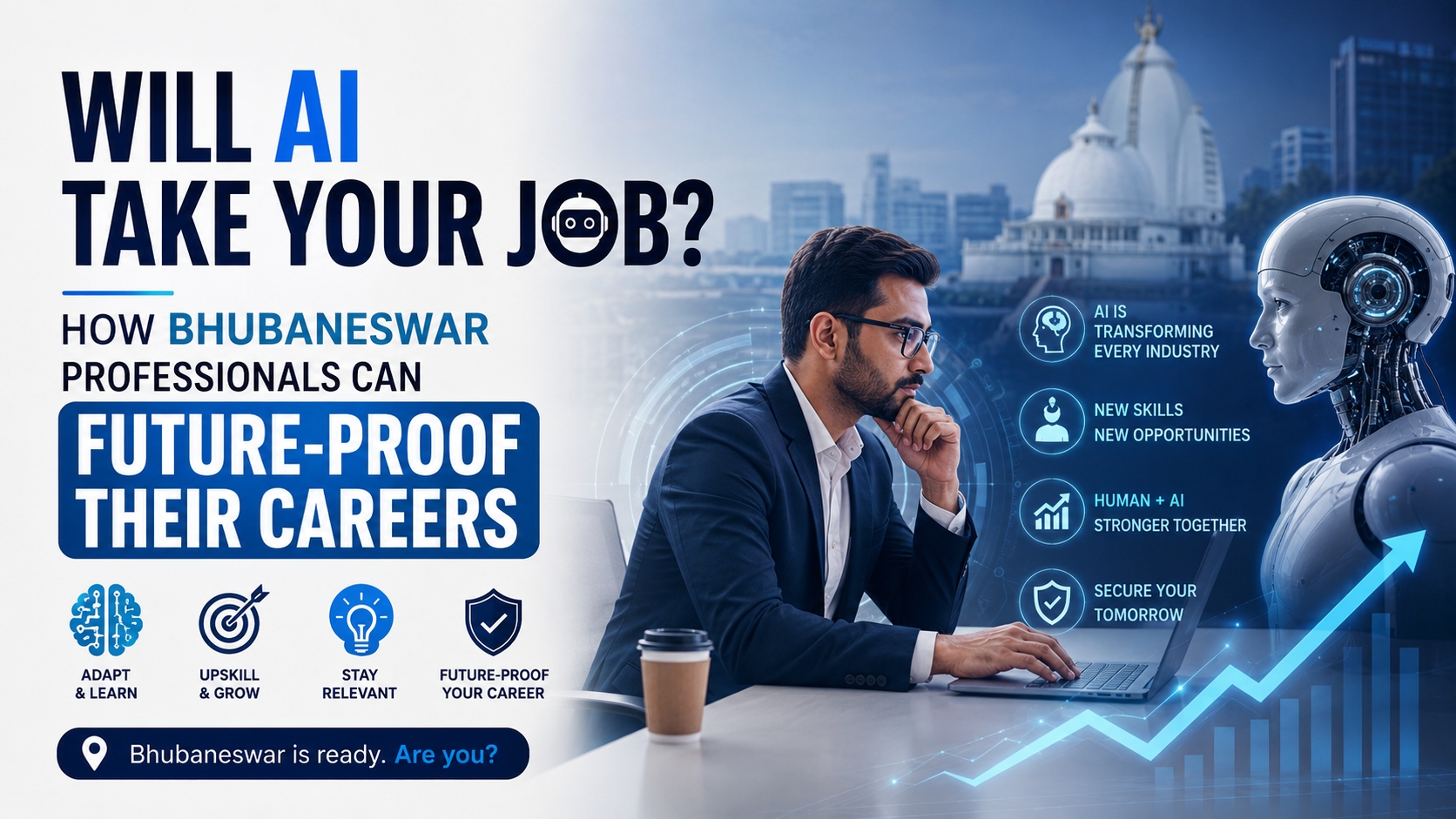
Will AI Take Your Job? How Bhubaneswar Professionals Can Future-Proof Their Careers
It's not AI that ends careers — it's staying static while everyone else adapts. Here's how to know exactly where you stand.