Career Audit vs Resume Writing: Which Do You Actually Need First?
When professionals decide it's time for a career change, the first instinct is almost always the same: "I need to update my resume." It feels productive. It feels like action. But here's the uncomfortable truth — rewriting your resume before you've clarified your direction is a bit like renovating a house before deciding whether you're even keeping it.
The Real Question Isn't "Resume or Audit" — It's "What Comes First"
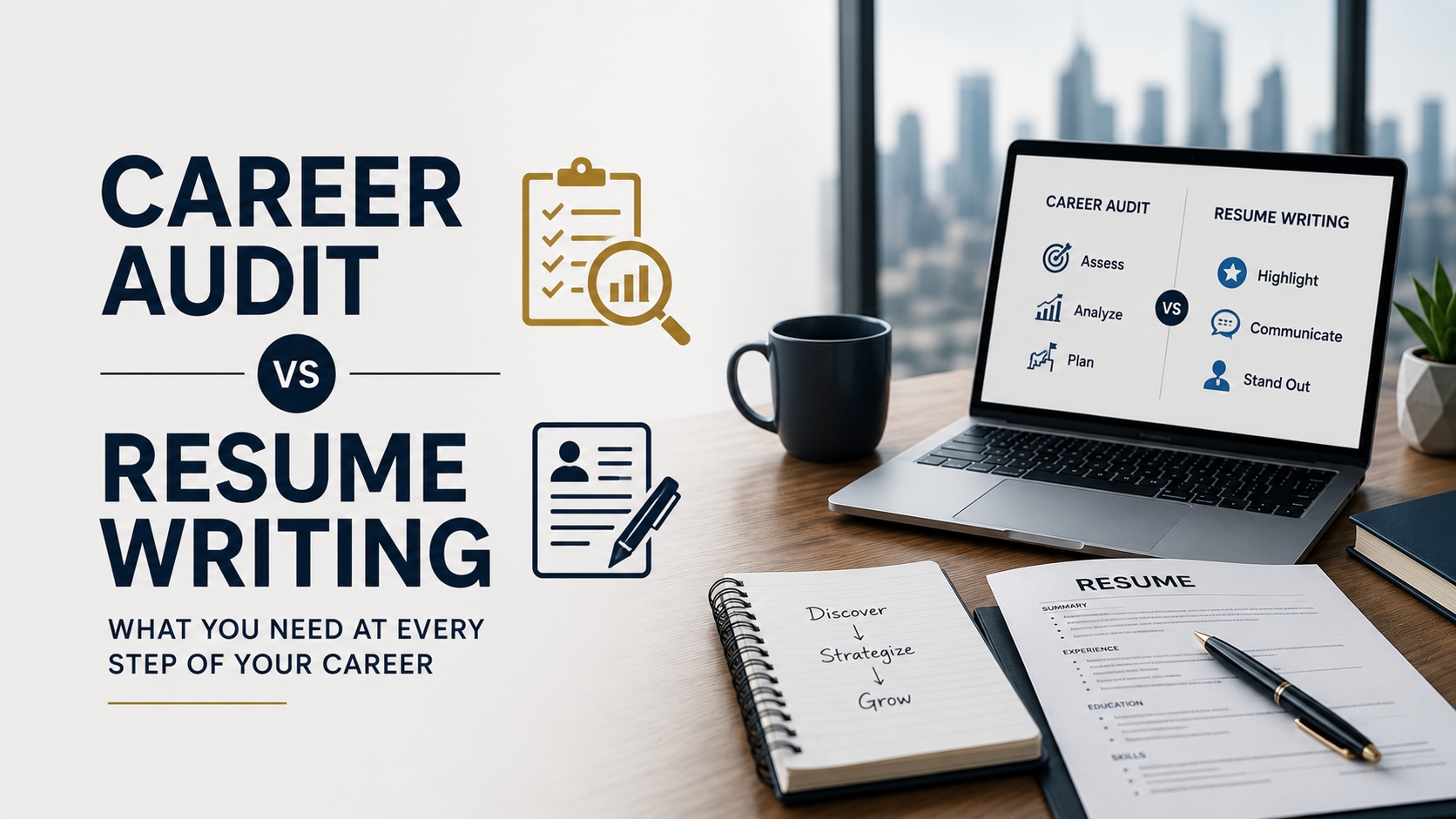
Both are useful. The question is sequencing. A resume communicates who you are and what you've done. A career audit determines what you should actually be communicating — and to whom. Get the order wrong, and you end up with a beautifully formatted resume aimed at the wrong roles entirely.
What a Resume Actually Does (and Doesn't Do)
A resume is a marketing document. Its job is to present your experience in the most compelling way possible for a specific target role or direction. That's it. A resume:
Cannot tell you which roles you're actually best suited for
Cannot reveal skill gaps holding you back from your next role
Cannot quantify your market value or employability
Cannot tell you if your current career trajectory is even the right one
In other words, a resume is excellent at execution but useless for direction. If you don't know your direction yet, no amount of resume polishing will fix that.
What a Career Audit Actually Does
A career audit does the work a resume can't:
Assesses your actual strengths and workstyle through psychometric evaluation
Benchmarks your employability against current market standards
Identifies specific skill gaps between where you are and where you want to be
Produces a career audit report with a clear, personalized roadmap
Only after this process do you actually know what your resume should say — which achievements to highlight, which skills to foreground, and which roles to target in the first place.
A Simple Analogy
Imagine hiring a copywriter to write an ad for your business — but you haven't decided yet what you're selling, who your customer is, or what makes you different. No matter how skilled the copywriter is, the ad will underperform, because the strategy was never defined. Resume writing without a career audit has the exact same problem: excellent execution of an undefined strategy.
The Cost of Skipping the Audit
Professionals who jump straight to resume writing often end up in one of these situations:
A resume optimized for the wrong role entirely, based on outdated assumptions about their career direction
Multiple resume rewrites over months, each time chasing a slightly different direction, because the underlying strategy was never settled
Interviews for roles that, in hindsight, weren't even a good fit — wasted time on both sides
A polished resume that still doesn't get responses, because the positioning, not the formatting, was the actual problem
Side-by-Side: What Each Actually Solves
Question: "How do I present my experience well?"
Resume Writing: Yes
Career Audit: Not directly
Question: "Am I even targeting the right roles?"
Resume Writing: No
Career Audit: Yes
Question: "What skills am I missing for my next step?"
Resume Writing: No
Career Audit: Yes
Question: "What's my market value right now?"
Resume Writing: No
Career Audit: Yes
Question: "How should I phrase my achievements?"
Resume Writing: Yes
Career Audit: No
Question: "What should my next 12-month plan look like?"
Resume Writing: No
Career Audit: Yes
When Resume Writing Alone Is Enough
To be fair, not everyone needs a full audit before touching their resume. If you already have strong clarity — you know your target role, your direction hasn't changed, and you just need better presentation — a resume refresh alone might be sufficient.
But if you're feeling any of the following, an audit should come first:
You're not sure what role to target next
You've been applying broadly with low response rates
You're considering a career switch but haven't clarified direction
You suspect your current path isn't the right long-term fit
How the Two Work Together
The most effective sequence looks like this:
Career audit — clarify direction, identify strengths, quantify employability, surface skill gaps
Personalized career plan — translate the audit findings into a concrete 6-12 month roadmap
Resume writing — now build a resume specifically aligned to the roles and positioning the audit revealed
This order ensures your resume isn't just well-written — it's strategically targeted, which matters far more to hiring managers and recruiters than formatting or word choice.
An Illustrative Example
Consider a working professional in operations who had rewritten their resume three times over eight months, each time tweaking keywords based on job postings, with little improvement in response rates. A career assessment for working professionals revealed that their strongest, most marketable skill set was actually in vendor negotiation and process design — something buried in bullet point four of their old resume, rather than positioned as the headline. Once the audit clarified this, the resume rewrite that followed took a fraction of the time and performed dramatically better, because the strategy was finally right.
What This Means for Your Job Search Timeline
It might feel counterintuitive to "slow down" and do an audit before jumping into applications — especially if you're eager to move fast. But in practice, the audit-first approach is usually faster overall, because it prevents the wasted cycles of applying broadly, getting weak responses, rewriting the resume again, and repeating the loop.
A structured career audit report typically takes 60-90 minutes to generate. Compare that to weeks or months of trial-and-error resume rewrites with no clear strategic anchor.
The CoacHR Approach
At The CoacHR, we intentionally sequence our process this way: career audit first, to build a data-backed foundation and personalized roadmap, and resume/positioning guidance second — so your resume finally reflects a clear, validated strategy rather than a guess.
Frequently Asked Questions
Q: Should I get my resume rewritten before or after a career audit?
After. The audit clarifies your direction and strengths, which makes the resume rewrite far more targeted and effective.
Q: I already know what role I want — do I still need an audit?
If you have strong clarity already, a resume refresh alone may be sufficient. An audit is most valuable when direction is unclear.
Q: Can a career audit help even if I'm not job searching right now?
Yes — it's useful for long-term planning, identifying skill gaps early, and preparing before you actually need to search.
Q: Does The CoacHR offer resume support after the audit?
Our process is designed to move from audit findings into a personalized roadmap, which directly informs your resume positioning and targeting.
Before you touch your resume again, get clear on your direction. Book a career audit with The CoacHR first.
https://thecoachr.com/